
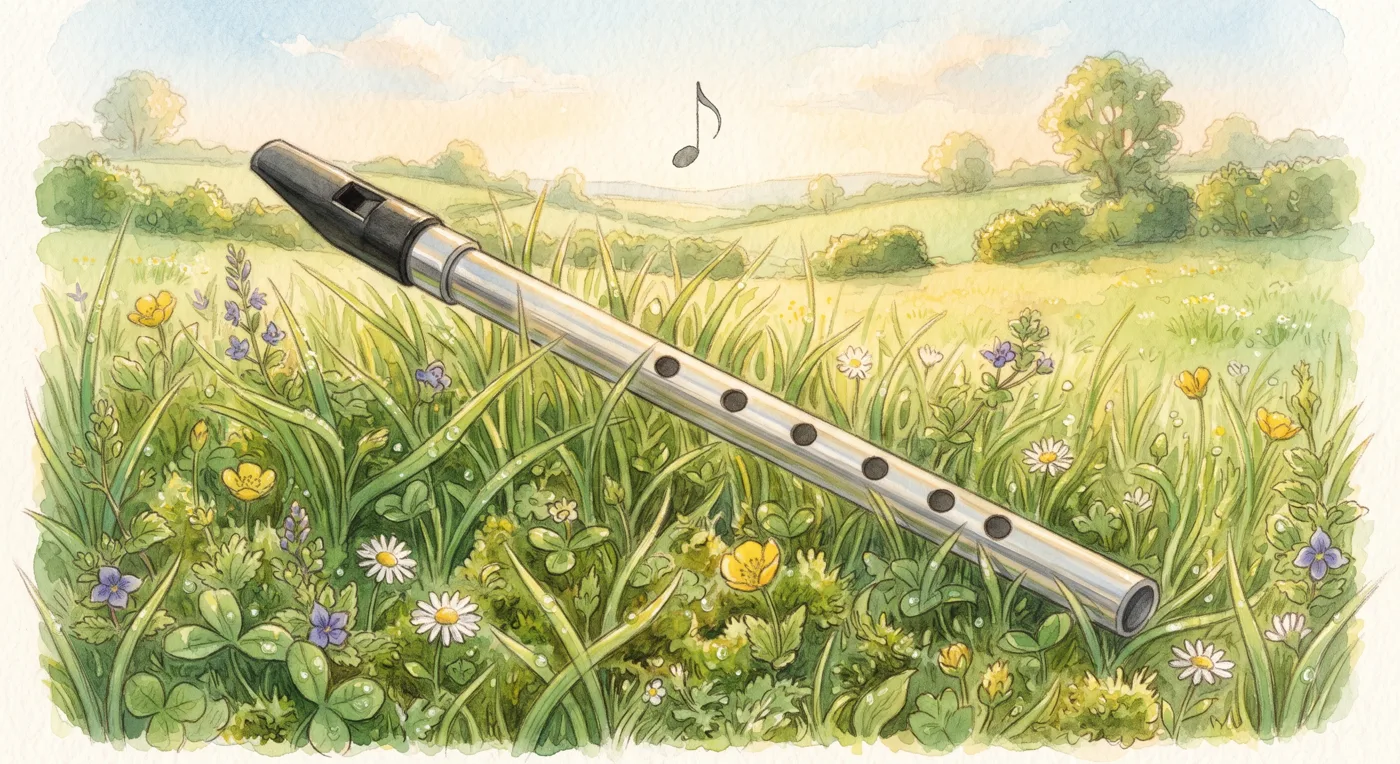
Famous music for the tin whistle
The tin whistle is small, but its music travels far. Most of it was never written by one person: it's tunes passed from player to player, often by ear.
Irish traditional music
The whistle's home is Irish traditional music. Much of it is dance music: jigs (bouncy, in groups of three), reels (fast and flowing, in fours), hornpipes and polkas. Musicians meet at sessions, sit in a circle and play tune after tune together, whistles beside fiddles, flutes, pipes and accordions.
Then there are slow airs: song melodies played freely and gently, where every note has room to breathe. They are a beautiful place to start, because there is no hurry.
The little turns
Irish players decorate their tunes with ornaments: a cut (a quick flick of a finger above the note), a tap (a quick flick below), and a roll, which joins them. These tiny sounds give the music its lilt. They come later, once the notes feel easy.
Tunes you may know
The Irish Washerwoman is a well-known jig. The Londonderry Air, a melody first published in the 1850s, is famous today as the tune of Danny Boy. Down by the Salley Gardens sets a poem by W. B. Yeats to an old Irish air. All of them are traditional, and they belong to everyone.
Players
Willie Clancy (1918–1973), a piper and whistle player from County Clare, is remembered every summer by a music school in his name in Miltown Malbay. Mary Bergin's recordings of the whistle, from the late 1970s on, inspired many players. Today the whistle is heard in folk bands, in film soundtracks and in sessions all over the world.
Kwela
In the townships of South Africa in the 1950s, young musicians played penny whistles on street corners, over a guitar's swinging beat. The music was called kwela, and players such as Spokes Mashiyane made records that were heard across the country. It's a happy reminder that one little instrument can belong to many peoples.
Where our lessons begin
Our lessons start with simple songs from everywhere, like Hot Cross Buns, Mary Had a Little Lamb and Ode to Joy (Ode an die Freude). The jigs and reels are waiting further down the road.